
What a trade costs you
What a Memecoin Trade Costs You: Every Fee on a Solana Trade
List the costs of a memecoin trade, and say which ones you control and which ones you don't.
Thinking the only cost of a trade is the price of the coin. Fees are charged on the way in and again on the way out, so a coin has to rise before you're even back where you started.
Key terms in this chapter
- priority fee
- When many people trade at once, transactions that pay extra tend to be recorded first. That extra is the priority fee.
Six costs, one trade
Chapter 1.1 said every transaction carries a small fee in SOL. That's only the first of several costs in a memecoin trade.
| Cost | What it is | Who controls it |
|---|---|---|
| Network fee | Solana's basic fee for recording the transaction | No one: it's fixed |
| Priority fee | An optional extra you pay to be recorded sooner | You |
| Pool fee | A percentage of every trade, taken by the pool | The pool |
| App fee | A percentage some trading apps and bots add on top | The app you choose |
| Deposit | SOL locked the first time you hold a coin, returned later | No one, but you can get it back |
| Price impact | How much your own trade moves the price (chapter 1.6) | You, through trade size |
The fees, one by one
Network fee. Solana's documentation sets it at 5,000 lamports per signature, which is 0.000005 SOL for a simple trade. You can ignore it.
Priority fee. When many people trade at once, transactions that pay extra tend to be recorded first. That extra is the priority fee. Solana's documentation describes it as optional. Your app may set it for you; check what it's using, because it can be many times the network fee.
Pool fee. Most pools keep a percentage of every trade. On pump.fun's bonding curve (chapter 1.9), the total fee starts at 1.25% of each trade and falls as the coin's market cap grows; part of it goes to the coin's creator. Regular pools often charge less.
App fee. Many trading apps and bots add their own percentage. It's usually shown on the confirmation screen or in the app's fee page. Read it before your first trade, not after.
Deposit. The first time you hold a coin, Solana opens a small account in your wallet to record your balance. It locks a deposit of about 0.0015 SOL. It's not a fee: when you've sold the coin and close that empty account, the SOL comes back.
$PEBBLE: one buy, one sell
You buy 1 SOL of $PEBBLE on its curve, with no app fee, and sell it again straight away at the same price.
| Buy | Sell | |
|---|---|---|
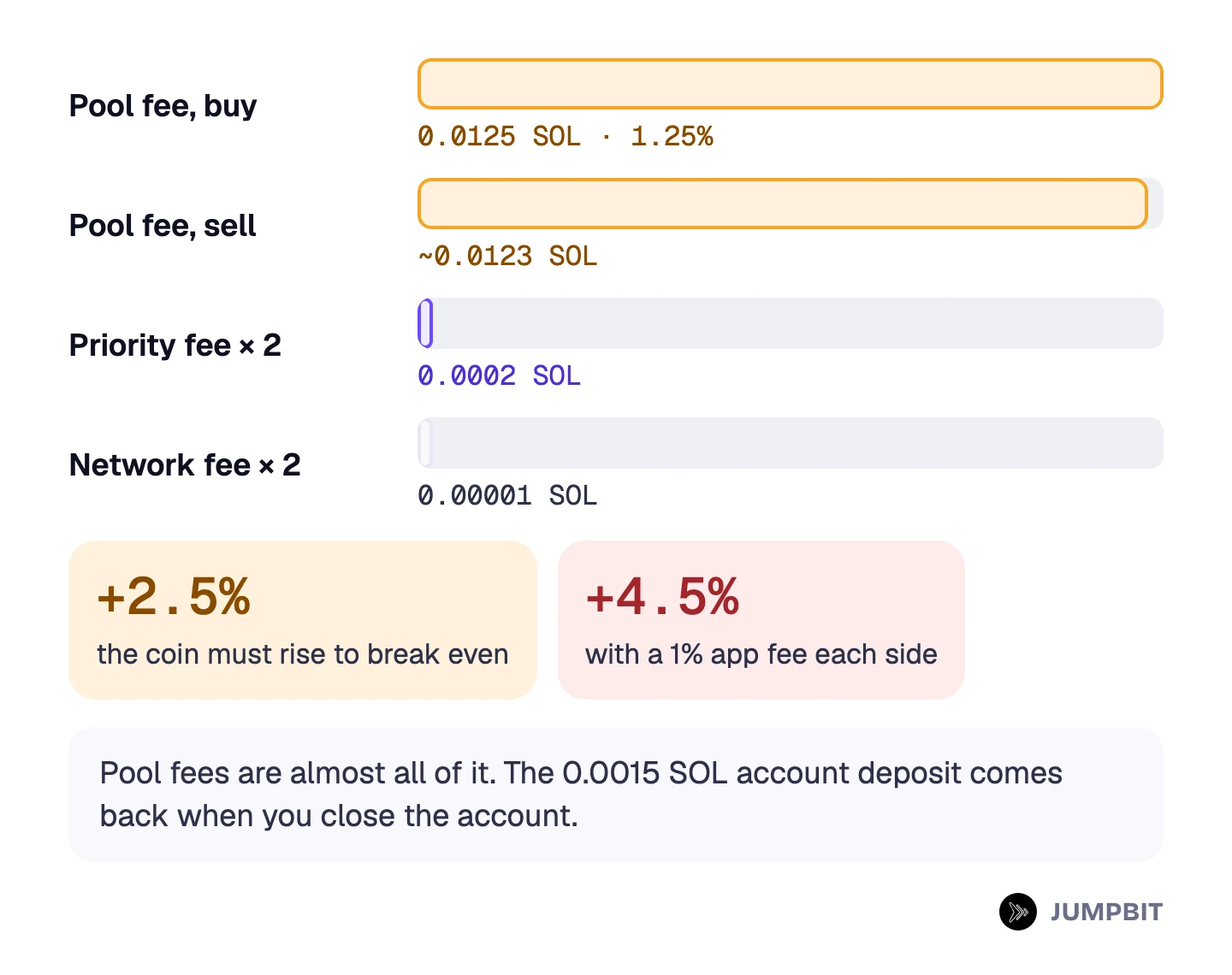
| Pool fee at 1.25% | 0.0125 SOL | About 0.0123 SOL |
| Network fee | 0.000005 SOL | 0.000005 SOL |
| Priority fee you chose | 0.0001 SOL | 0.0001 SOL |
| Deposit | 0.0015 SOL, returned later | — |
The fees on the way in and out add up to about 0.025 SOL, or 2.5%. $PEBBLE has to rise by about 2.5% before you've made back what you paid. Add an app fee of 1% on each side, and it's closer to 4.5%.
Price impact isn't charged like a fee, so it's not in the $PEBBLE table. It's the gap between the price you see and the price you get, on the way in and on the way out. In a small pool it's often bigger than every fee combined (chapter 1.6).
The rule
Know every percentage before you trade, and remember you pay most of them twice. The ones you control are the priority fee, your trade size and the app you use.
Check yourself
Say your answer out loud or in your head first. Then open it and be honest about whether you got it.
- 1Which costs of a trade can you control?
- 2You pay 1.25% to the pool on a buy and 1.25% on a sell. Roughly how much does the coin have to rise before you're back where you started?
- 3The first time you hold a coin, about 0.0015 SOL leaves your wallet. Is it gone for good?
- 4What does a priority fee buy you?
- 5Where do you find a trading app's own fee before your first trade?
- 6You trade with a 1.25% pool fee and a 1% app fee on each side. Roughly how much must the coin rise for you to break even?
- 7Recap · 1.6Your buy is a large part of the SOL in a pool. Which cost becomes the biggest?
Go deeper
Education, not financial advice. Crypto can lose all its value.