
Why your buy moves the price
Why Your Buy Moves the Price: Price Impact vs Slippage on Solana
Tell price impact from slippage, and estimate how much your own trade will move a pool's price.
Expecting a trade to fill at the price on screen. Your own trade moves the price while it fills, and in a small pool that can cost more than every fee combined.
Key terms in this chapter
- price impact
- This is called price impact: how much your own trade moves the price.
- Slippage
- Slippage is that extra gap between the price you saw and the price you got, caused by other trades landing before yours.
- slippage tolerance
- Trading apps ask you for a slippage tolerance, such as 1% or 10%.
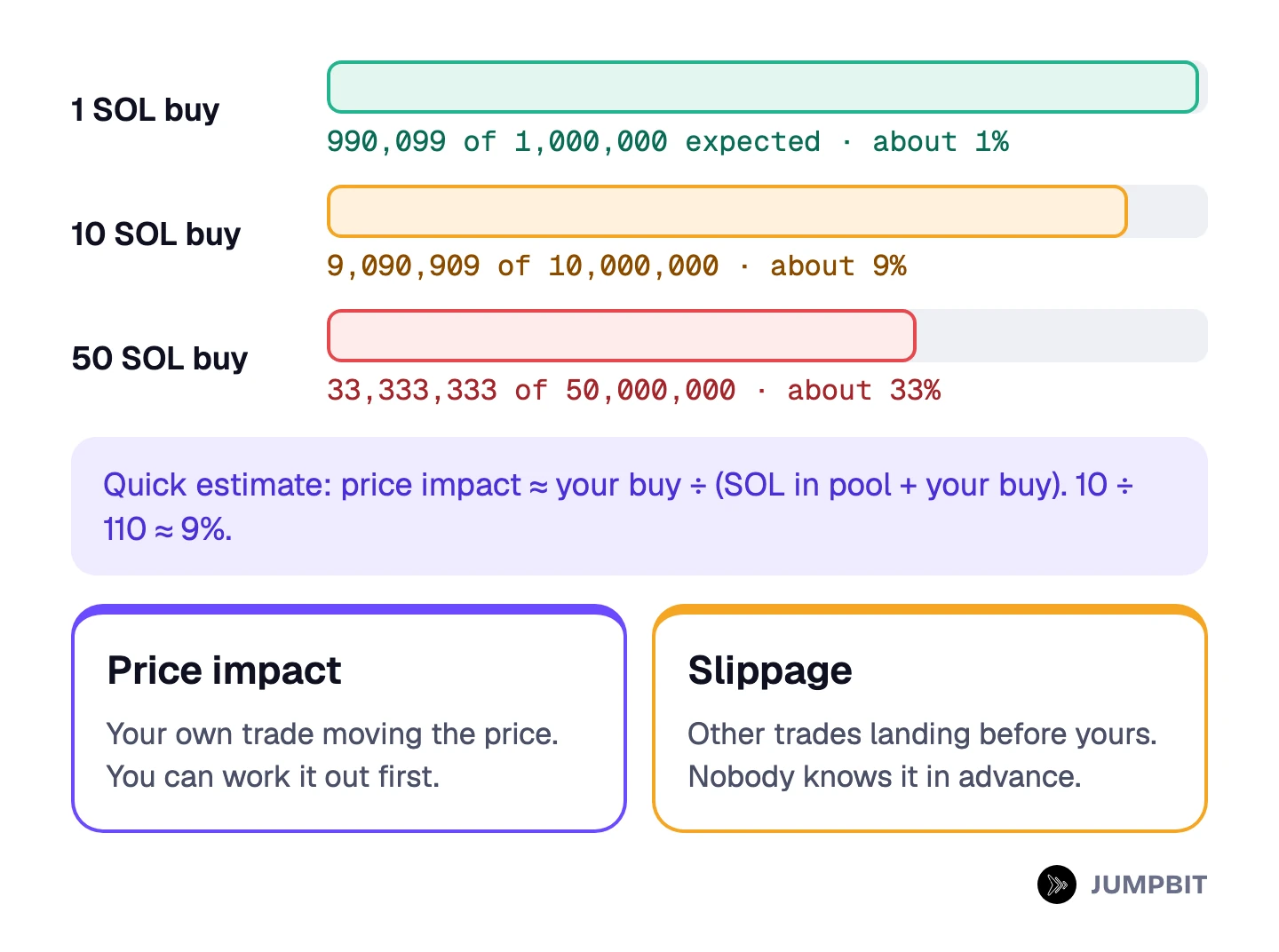
Your buy changes the price as it fills
Chapter 1.5 showed that every buy adds SOL to the pool and takes coins out, which raises the price. That includes your buy. The first part of your order fills near the price on screen, and each later part fills a little higher. You end up paying an average that's worse than the price you saw.
This is called price impact: how much your own trade moves the price. It depends on two things only: how big your trade is and how big the pool is.
The same buy in two pools
$PEBBLE's pool holds 100 SOL and 100,000,000 PEBBLE, so the price on screen is 0.000001 SOL. At that price, 1 SOL "should" buy 1,000,000 PEBBLE.
| Your buy | Coins you'd expect | Coins you get | Price impact |
|---|---|---|---|
| 1 SOL | 1,000,000 | 990,099 | About 1% |
| 10 SOL | 10,000,000 | 9,090,909 | About 9% |
| 50 SOL | 50,000,000 | 33,333,333 | About 33% |
A quick way to estimate it: price impact is roughly your trade divided by the SOL in the pool plus your trade. 10 SOL into a 100 SOL pool is 10 ÷ 110, about 9%.
Now put the same 10 SOL into a coin whose pool holds only 10 SOL. Your buy is half of everything in the box after it lands, and you get only about half the coins the screen promised.
Slippage is the price moving before you
Your trade isn't filled the instant you press buy. Other buyers and sellers may land first, and their trades move the price before yours fills. Slippage is that extra gap between the price you saw and the price you got, caused by other trades landing before yours.
Price impact you can work out in advance. Slippage you can't, because it depends on who else trades at the same moment.
What the slippage setting does
Trading apps ask you for a slippage tolerance, such as 1% or 10%. It's the worst price you'll accept. If the price moves further than that before your trade fills, the trade fails and you keep your SOL, minus the small network fee.
A high tolerance makes a busy trade more likely to go through, but it's also a promise to accept that bad a price. Some bots watch for buys with high tolerance and trade just before and just after them to take the difference. Raise it only as far as you need.
The rule
Before you buy, compare your trade to the SOL in the pool. If your trade is a large part of it, you'll move the price a lot, and you'll move it again when you sell.
Check yourself
Say your answer out loud or in your head first. Then open it and be honest about whether you got it.
- 1What's the difference between price impact and slippage?
- 2Roughly how much price impact does a 5 SOL buy have in a pool holding 45 SOL?
- 3Before you buy, what one comparison tells you how much you'll move the price?
- 4You can work out price impact before you trade. Why can't you work out slippage?
- 5Your slippage tolerance is 2%, and the price moves 5% before your trade fills. What happens?
- 6Why can a very high slippage tolerance cost you?
- 7Recap · 1.5A pool holds 100 SOL and 100,000,000 coins. What is the price of one coin?
Education, not financial advice. Crypto can lose all its value.