
How most coins start: the curve and graduation
Bonding Curve and Graduation: How New Memecoins Start, and How Few Make It
Describe how a bonding curve works, what graduation means, and how rare it is.
Thinking most new coins make it, or that a coin that graduated must have real buyers. Only about 1 launch in 30 to 40 graduates, and many that do were bought up by a handful of wallets.
Key terms in this chapter
- bonding curve
- Launch sites solve this with a bonding curve: the coins are held by the launch program itself, and it sells them at a price that rises as more are bought and falls as they're sold back.
- graduation
- The coin's SOL and remaining coins then move into a regular pool, and trading carries on there. That move is called graduation.
The curve: a pool with no one's money in it yet
A brand-new coin has no pool, because nobody has put SOL in yet. Launch sites solve this with a bonding curve: the coins are held by the launch program itself, and it sells them at a price that rises as more are bought and falls as they're sold back.
It works like the box from chapter 1.5, with one difference. At the start, the SOL side is imaginary. The program pretends the box holds some SOL so the first coin has a price above zero. Real SOL builds up only as people buy.
Graduation: the curve fills
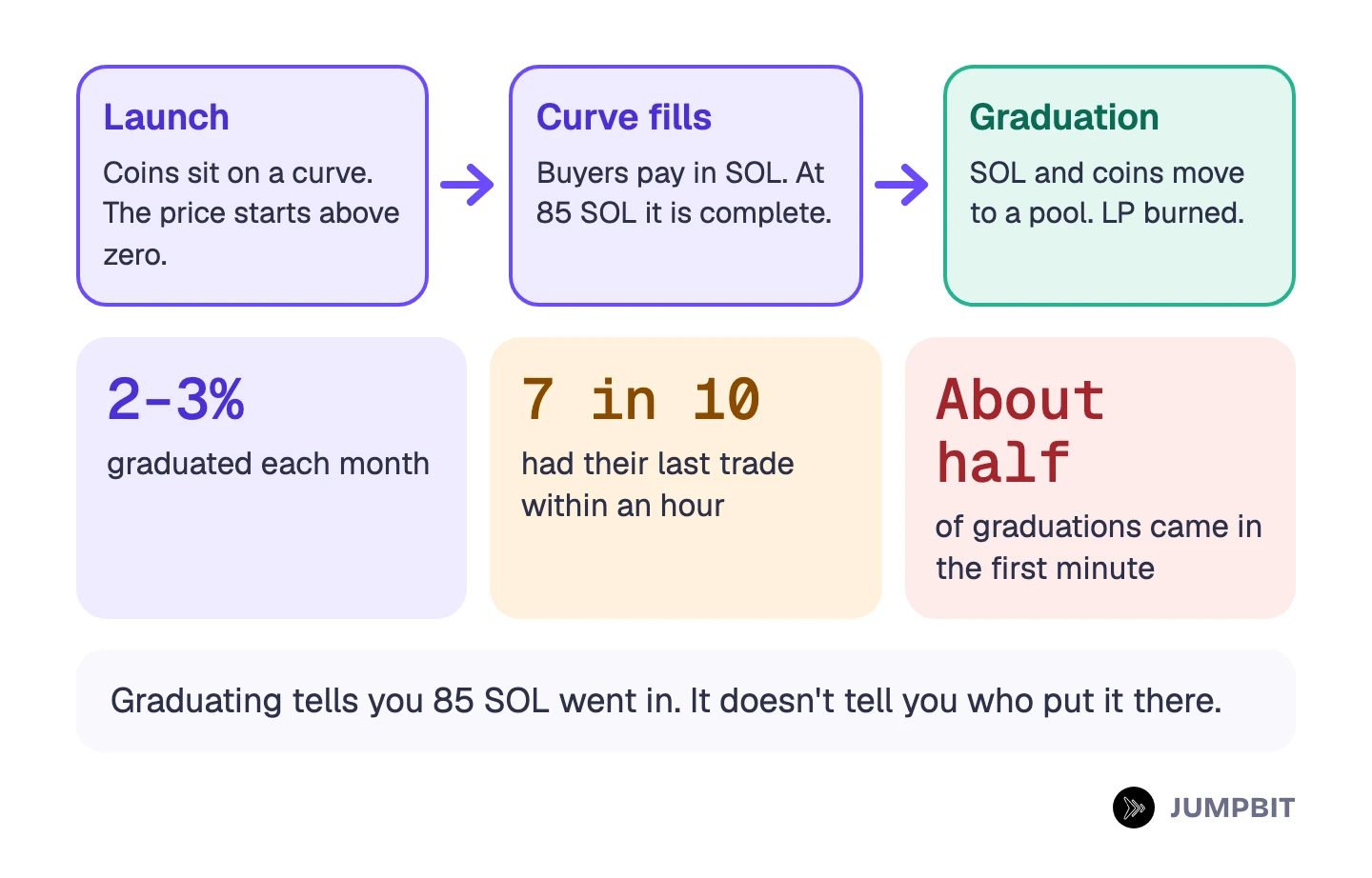
When enough SOL has been paid in, the curve is complete. On pump.fun, the launch site our data below covers, that happens when the curve holds 85 SOL. The coin's SOL and remaining coins then move into a regular pool, and trading carries on there. That move is called graduation.
On pump.fun, the pool a graduated coin moves to is set up so nobody can pull its liquidity. Coins whose pools are created in other ways may not have that protection (chapter 2.5).
How rare graduation is
We followed every pump.fun launch from 1 August to 15 October 2026, 2.9 million coins in all.
| August | September | October 1–15 | |
|---|---|---|---|
| Launches | 1,173,153 | 1,000,569 | 733,934 |
| Graduated | 2.82% | 3.38% | 2.35% |
| Still traded a week later | 8.9% | 8.8% | 4.0% |
About seven in ten launches had their last trade within an hour of being created.
Graduating doesn't mean people want it
In the same data, about half of all graduations happened within one minute of the coin's first trade. A third of graduated coins had five or fewer wallets trading on the curve.
Filling 85 SOL in under a minute with five wallets isn't a crowd discovering a coin. It's usually the creator, or a small group working together, buying the curve out themselves. Module 3 shows how to spot it.
What happens to $PEBBLE
$PEBBLE launches on a curve. If it's like most launches, it never fills, trading stops within the hour, and the coins stay worth almost nothing. If it graduates, that tells you 85 SOL went in. It doesn't tell you who put it there.
Check yourself
Say your answer out loud or in your head first. Then open it and be honest about whether you got it.
- 1What does it mean when a coin graduates?
- 2About how many pump.fun launches graduated each month in our 2026 data?
- 3Why does a bonding curve pretend to hold some SOL at the start?
- 4On pump.fun, how much SOL must the curve hold for a coin to graduate?
- 5A coin graduated a minute after its first trade, with five wallets trading on the curve. What does that usually mean?
- 6In our data, roughly how many launches had their last trade within an hour of being created?
- 7Recap · 1.8A graduated coin shows a big market cap. Does that mean holders could sell it for that much?
Go deeper
Education, not financial advice. Crypto can lose all its value.