
Market cap isn’t money you can take out
Market Cap Isn't Money You Can Take Out: Liquidity vs Market Cap
Explain why the SOL in a coin's pool, not its market cap, limits what holders can sell for.
Thinking market cap is the cash value of a coin, so holders could sell it all for that amount. Sellers can only take out the SOL that's actually in the pool, and each sale makes the next one worse.
Key terms in this chapter
- liquidity
- How much a pool holds is called its liquidity.
Two numbers that sound alike
Chapter 1.7 showed that market cap is price times supply. It's a useful way to compare the size of two coins, but it's a calculation, not a pile of money. Nobody has ever paid that amount, and nobody can take it out.
The money that's really there sits in the pool (chapter 1.5). How much a pool holds is called its liquidity. When someone sells coins, the SOL they receive comes out of that pool, and from nowhere else.
$PEBBLE: market cap against the pool
| $PEBBLE | |
|---|---|
| Supply | 1,000,000,000 PEBBLE |
| Price | 0.000001 SOL |
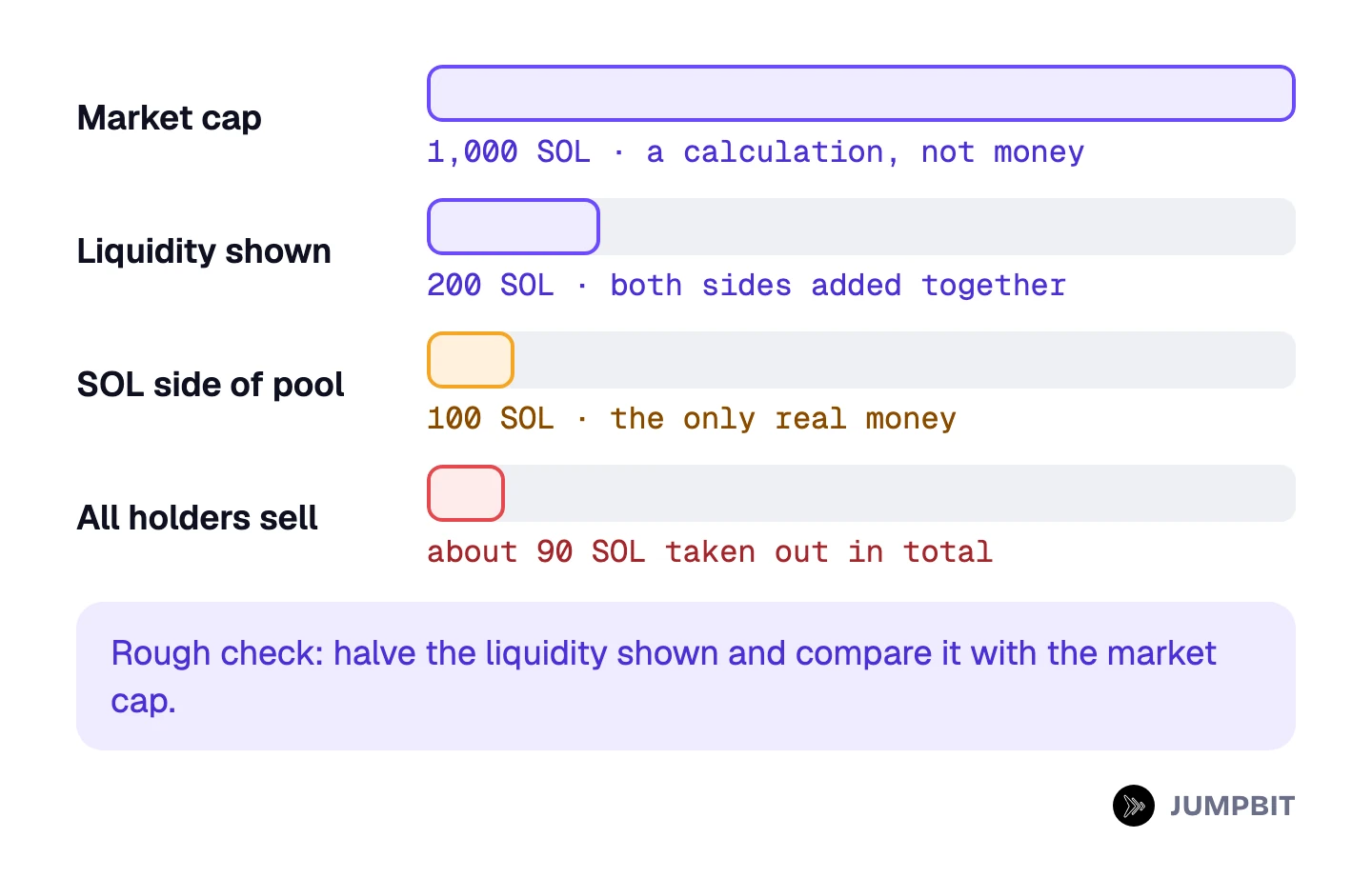
| Market cap | 1,000 SOL |
| In the pool | 100 SOL and 100,000,000 PEBBLE |
The other 900 million PEBBLE are held in wallets. Suppose every one of those holders sold, all together. Using the pool's rule from chapter 1.5, the pool would end up holding all 1 billion PEBBLE and 10 SOL.
So all the sellers together would take out 90 SOL. Not 1,000. And whoever sold first would get a far better price than whoever sold last.
Reading liquidity on screens
Screens usually show liquidity as the value of both sides of the pool added together. $PEBBLE's pool would show about 200 SOL of liquidity: 100 SOL plus 100 million PEBBLE valued at today's price. Only the SOL side is real money a seller can take out, and it shrinks with every sale.
A rough check that works on any coin: halve the liquidity shown, and compare it with the market cap. For $PEBBLE that's 100 SOL against 1,000 SOL, so the pool holds a tenth of the market cap. On many new coins the share is far smaller.
Why this matters
- A big market cap can hide a tiny pool. A coin can show a large market cap and still have so little SOL in its pool that a modest sale crashes the price.
- Selling costs more than buying feels. Price impact (chapter 1.6) applies to sells too, and many holders try to sell at the same moment when a price starts falling.
- The pool can be emptied in other ways. In some coins, whoever added the liquidity can take it back out. Chapter 2.5 shows how to check.
Jumpbit's Rug Check compares a coin's liquidity with its market cap and warns when a pool is thin, because small pools move hard on every trade.
Check yourself
Say your answer out loud or in your head first. Then open it and be honest about whether you got it.
- 1A coin's market cap is 500 SOL and its pool holds 20 SOL. Could holders sell the coin for 500 SOL?
- 2A screen shows a coin's liquidity as 60 SOL. Roughly how much SOL is on the SOL side of the pool?
- 3When you sell coins, where does the SOL you receive come from?
- 4$PEBBLE has a 1,000 SOL market cap and 100 SOL in its pool. If every other holder sold together, roughly how much SOL would they take out?
- 5Many holders sell at the same moment. Who gets the best price?
- 6Besides selling, how else can a pool's SOL disappear?
- 7Recap · 1.6You sell coins worth 10 SOL into a pool holding 10 SOL. Will you get close to 10 SOL?
Go deeper
Education, not financial advice. Crypto can lose all its value.