
Is a tenth-of-a-cent coin cheap?
Is a Low-Price Memecoin Cheap? Why Market Cap Matters, Not Price
Work out a coin's market cap from its price and supply, and compare two coins by market cap instead of price.
Thinking a coin with a tiny price is cheap or has more room to grow. A tiny price usually just means a huge supply, and it tells you almost nothing about the coin's size.
Key terms in this chapter
- supply
- When someone creates a token, they choose its supply: how many coins there are.
- market cap
- Price times supply is the market cap.
Price is the value of one coin
A coin's price (chapter 1.5) is what one coin trades for. On its own, that number is close to meaningless, because it depends on how many coins exist.
When someone creates a token, they choose its supply: how many coins there are. Many memecoins pick a billion, and some pick a trillion. Spread the same value over a trillion coins and each one is worth very little.
Market cap is the value of all of them
To know how big a coin is, multiply its price by its supply:
market cap = price × supply
Price times supply is the market cap. Two coins with the same market cap are the same size, whatever their prices are.
Which coin is cheaper?
| Coin A | Coin B | |
|---|---|---|
| Price | $0.0001 | $5 |
| Supply | 1,000,000,000,000 | 1,000,000 |
| Market cap | $100,000,000 | $5,000,000 |
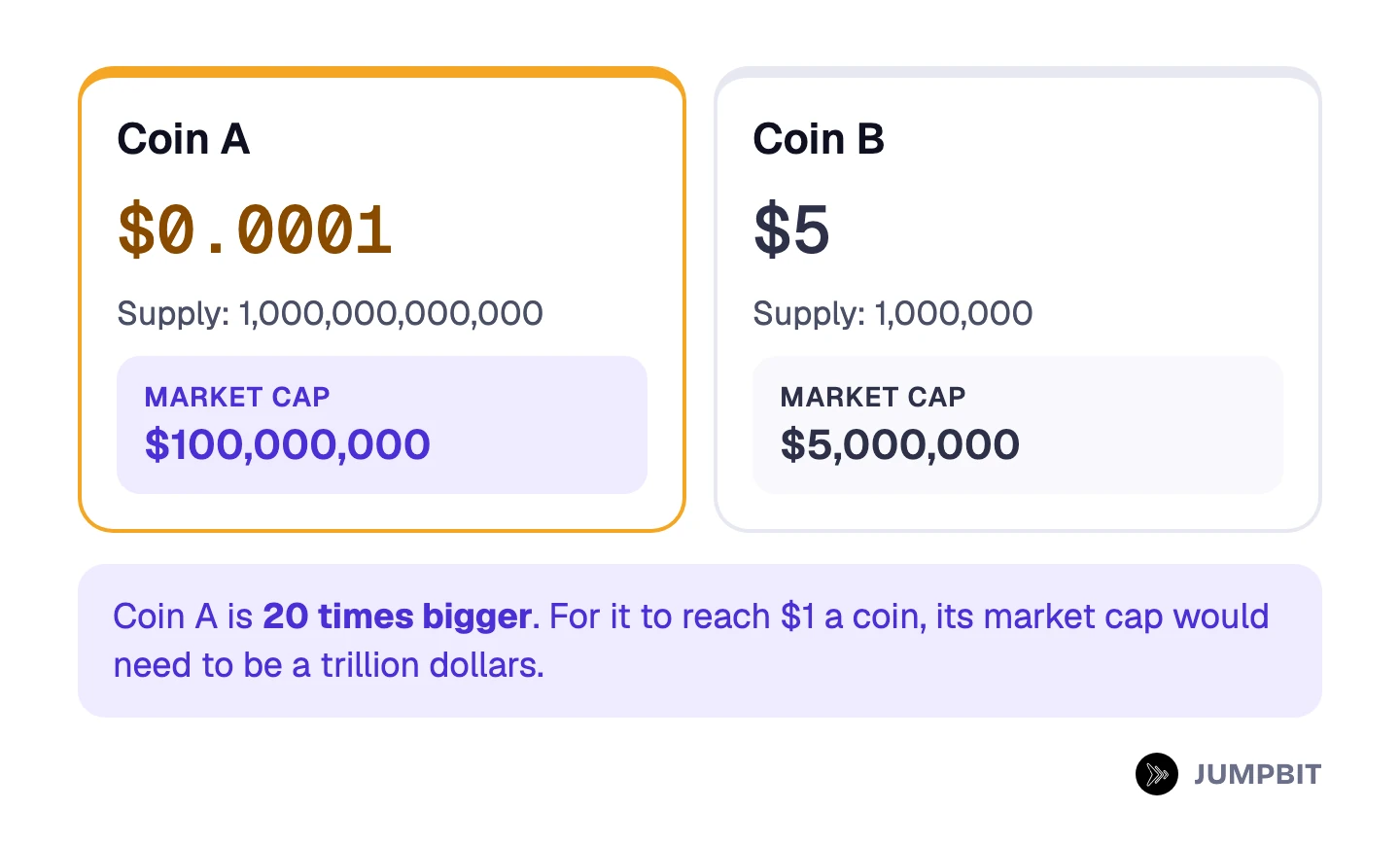
Coin A has the tinier price, but it's twenty times bigger than coin B. For coin A to reach $1 per coin, its market cap would have to reach a trillion dollars, which few companies on Earth have ever reached.
$PEBBLE has a supply of 1,000,000,000. At 0.000001 SOL per coin, its market cap is 1,000 SOL. If its creator had picked a supply of 1,000,000 instead, each coin would cost 0.001 SOL and nothing else about the coin would be different.
Why tiny prices are popular
A price like $0.00001 feels like a bargain, and a coin you can own a million of feels like more. Neither changes what you're buying. Comparing prices across coins is like comparing two pizzas by the size of one slice without asking how many slices each was cut into.
The rule
Compare market caps, never prices. When a coin "only" costs a fraction of a cent, check its supply first.
Check yourself
Say your answer out loud or in your head first. Then open it and be honest about whether you got it.
- 1Coin A is $0.001 with 1 billion coins. Coin B is $2 with 1 million coins. Which is bigger?
- 2Why do many memecoins have a price below a cent?
- 3How do you work out a coin's market cap?
- 4If $PEBBLE's creator had chosen a supply of 1 million instead of 1 billion, what would change?
- 5A coin with a supply of one trillion costs $0.0001. What would its market cap need to be for one coin to reach $1?
- 6A friend says a coin is a bargain because they can own a million of them. What do you check?
- 7Recap · 1.5What sets a coin's price in a pool?
Go deeper
Education, not financial advice. Crypto can lose all its value.