
How a coin gets a price: the box
How a Memecoin Gets Its Price: The Liquidity Pool Explained Simply
Explain how the two sides of a liquidity pool set a coin's price, and what happens to the price when someone buys or sells.
Thinking someone sets a memecoin's price, or that each buy is matched with a person selling to you. Most memecoin trades are made against a pool, and the pool's contents set the price.
Key terms in this chapter
- liquidity pool
- A box like this, where anyone can swap SOL for a coin and back, is called a liquidity pool, or pool for short.
A box with two stacks
Picture a box with two stacks inside: one of SOL, one of a coin. Anyone can walk up to the box and swap. Put SOL in and take coins out, and you've bought. Put coins in and take SOL out, and you've sold.
A box like this, where anyone can swap SOL for a coin and back, is called a liquidity pool, or pool for short. Most memecoins on Solana are bought and sold this way. There's no person on the other side of your trade and no one deciding the price.
The price is the ratio
A coin's price in the pool is how much SOL sits in the box for each coin in it:
price = SOL in the pool ÷ coins in the pool
Here is $PEBBLE's pool:
| In the pool | |
|---|---|
| SOL | 100 |
| $PEBBLE | 100,000,000 |
| Price | 100 ÷ 100,000,000 = 0.000001 SOL per PEBBLE |
Why buying pushes the price up
The pool follows one rule: when someone trades, the SOL stack multiplied by the coin stack has to stay the same. That rule is called constant product, and many Solana pools use it, including the one most new memecoins start on (chapter 1.9).
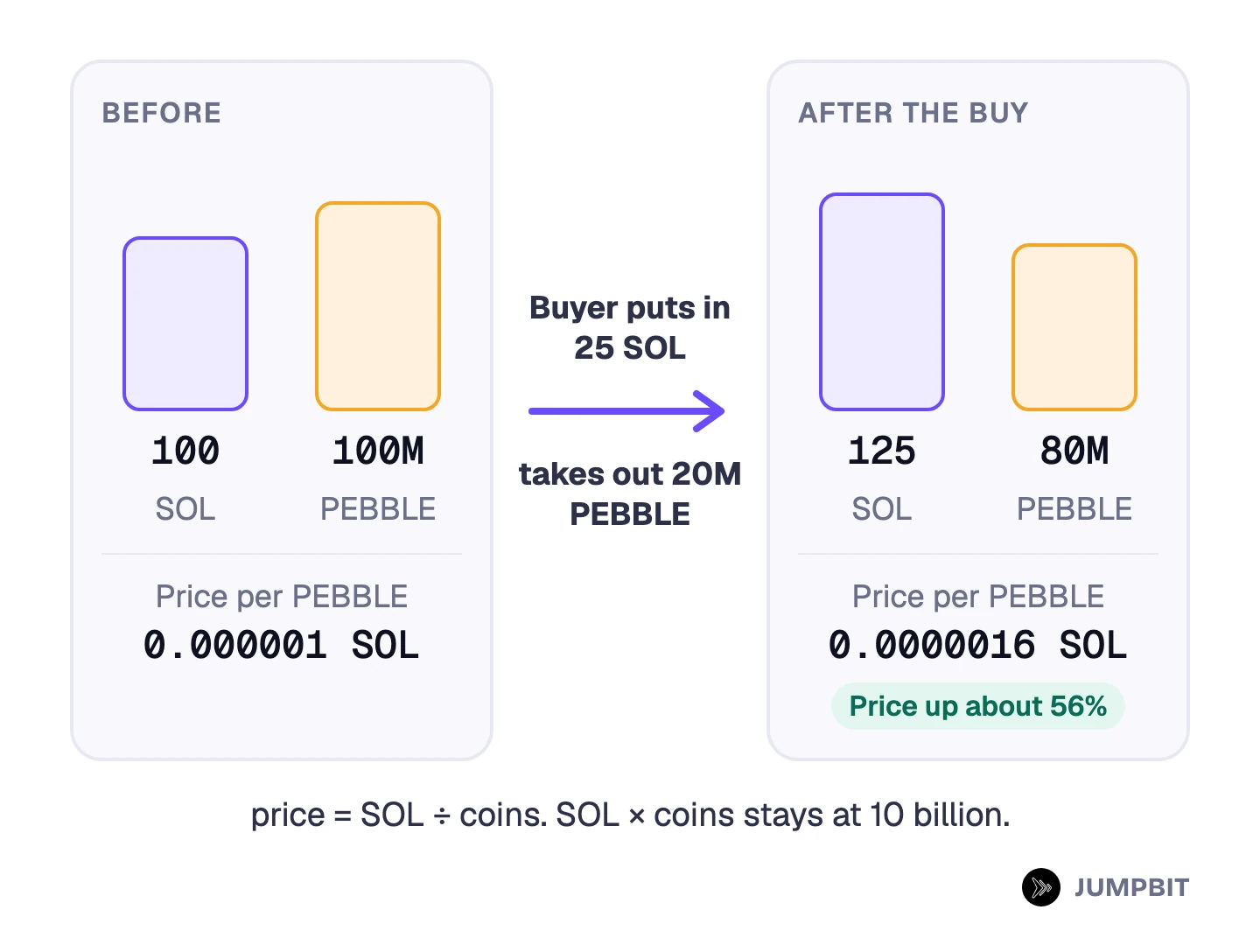
So when a buyer adds SOL, the pool must hand back enough coins that the two stacks still multiply to the same number. Say a buyer puts in 25 SOL:
| Before | After a 25 SOL buy | |
|---|---|---|
| SOL | 100 | 125 |
| $PEBBLE | 100,000,000 | 80,000,000 |
| Price | 0.000001 SOL | 0.0000015625 SOL |
Both columns multiply to 10 billion. The buyer received 20 million PEBBLE. Because the box now has more SOL and fewer coins, each coin costs more: the price rose by about 56%.
Selling works in reverse. Coins go in, SOL comes out, and the price falls.
What this means for you
- Every buy raises the price and every sell lowers it. That's all a price chart is: a record of trades against the pool.
- Small pools move fast. In a pool with only a few SOL, one buyer can double the price, and one seller can halve it. Chapter 1.6 shows what that does to your own trade.
- The price on screen is the last trade's result. It isn't an offer anyone has promised to honour.
Check yourself
Say your answer out loud or in your head first. Then open it and be honest about whether you got it.
- 1A pool holds 20 SOL and 40,000,000 coins. What is the price of one coin?
- 2Someone sells a lot of coins into a pool. Does the price go up or down, and why?
- 3What is a liquidity pool?
- 4Under the constant product rule, what stays the same after every trade?
- 5A buyer puts 25 SOL into a pool of 100 SOL and 100,000,000 coins. How many coins come out?
- 6Is the price on screen a promise that you can trade at it?
- 7Recap · 1.4You want to look up $PEBBLE's pool. What do you search with: its name or its contract address?
Go deeper
Education, not financial advice. Crypto can lose all its value.