
Who actually comes out ahead
Who Actually Comes Out Ahead in Memecoins, and Where Their Profit Comes From
Explain where a memecoin seller's profit comes from, and why most buyers of most coins don't come out ahead.
Thinking most people make money on memecoins. The profit of the people who come out ahead is paid for by the people who bought later, and fees take a cut from everyone on the way.
Follow the SOL
A memecoin doesn't make money. It has no sales, no profits and pays nobody anything (chapter 1.2). So when someone sells a memecoin for more SOL than they paid, that SOL had to come from somewhere.
It came from the pool (chapter 1.5), and the pool's SOL came from buyers. Every SOL that sellers take out was paid in by someone who bought.
SOL taken out by sellers = SOL paid in by buyers − fees − SOL still left in the pool
Fees go to the pool, the platform, the app and the network (chapter 1.10), and they come out of every trade, winning or losing.
$PEBBLE from start to finish
Here's one simple way $PEBBLE's life could go, shown as SOL in and out of its pool:
| Who | Paid in | Took out | Result |
|---|---|---|---|
| Creator and early buyers | 20 SOL | 70 SOL | +50 SOL |
| Buyers during the run | 80 SOL | 40 SOL | −40 SOL |
| Late buyers near the top | 30 SOL | 6 SOL | −24 SOL |
| Fees, all trades | — | — | About 4 SOL gone |
| Left in the pool | — | — | 10 SOL, mostly unsellable at a good price |
Buyers paid in 130 SOL. Sellers took out 116. Everyone who came out ahead was paid by someone who didn't. And because fees and the leftover pool take a share too, the losses add up to more than the profits.
What our on-chain study found
We followed every wallet that bought at least one of the 404,210 pump.fun coins launched from 2 to 16 September 2026, through every trade up to 22 October. For each wallet, we added up the dollars it put in and the dollars it got back. Coins it never sold count as zero.
| Of 4,735,045 wallets that bought | Result |
|---|---|
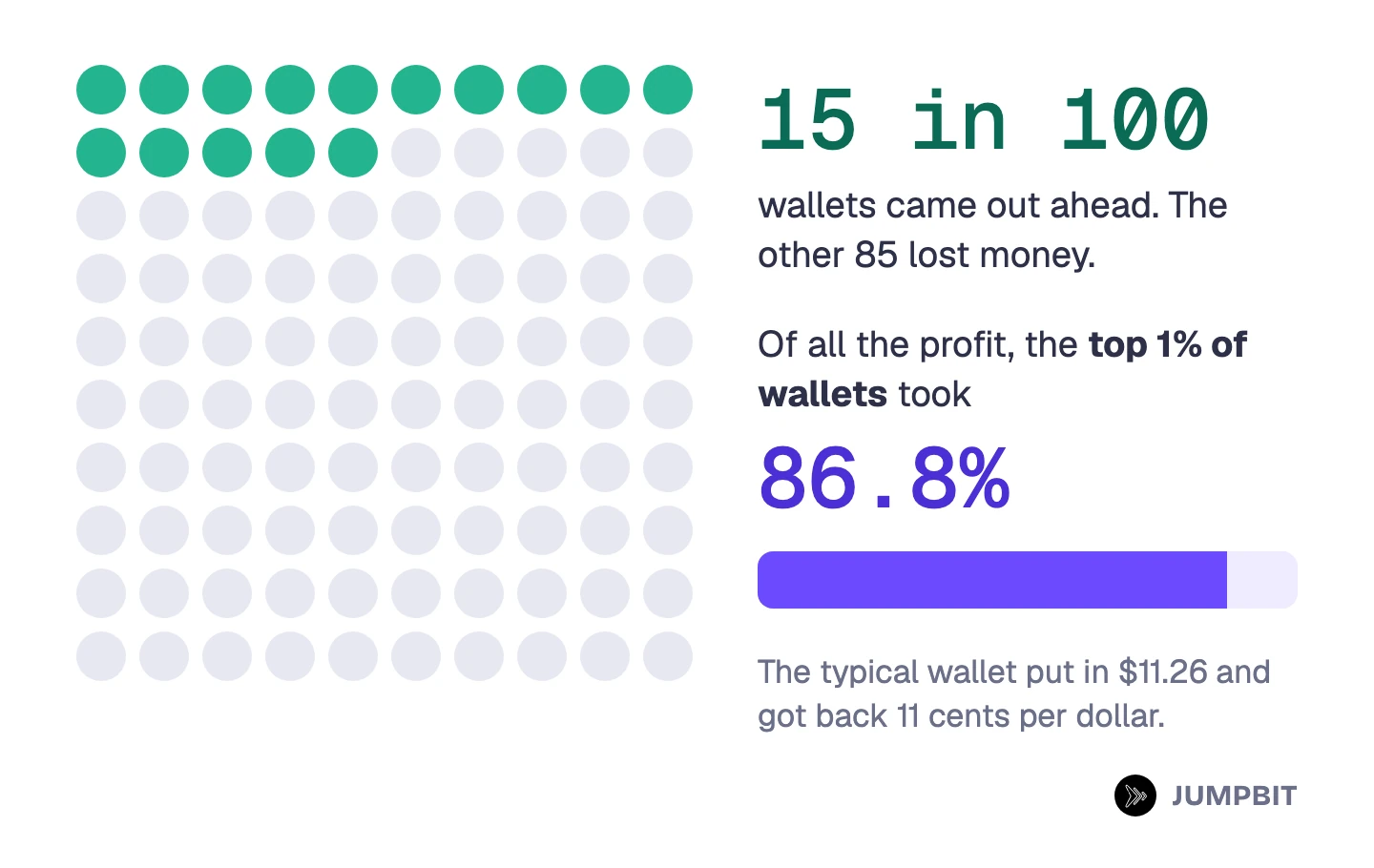
| Came out ahead | 14.7%, about 15 in 100 |
| The typical wallet put in | $11.26 |
| The typical wallet got back, per dollar put in | 11 cents |
| Got back less than half of what they put in | About 6 in 10 |
| Share of all profit taken by the top 1% of wallets | 86.8% |
We ran the same study on the next two weeks of launches, 16 to 30 September, and got almost the same answer: 14.1% came out ahead, and the top 1% again took 86.8% of the profit.
Wallets aren't people. One person can run many wallets, and bots are counted too.
Where the top 1% got their profit
Among the top 1% of wallets in the first two weeks:
- 17.7% of their profit came from coins they created themselves.
- 39.0% came from buying other people's coins within 2 seconds of launch, before any human could react.
That's more than half the profit of the biggest winners coming from being the creator or being first. It matches what module 3 taught: creators, snipers and bundles buy at the lowest price, and the crowd pays them.
Who tends to pay
The people who arrive after attention has already spread, which is usually when beginners first hear about a coin. Most coins in the study stopped trading within an hour of launch (about 67%), so for most coins there was no later buyer to sell to.
This doesn't mean nobody wins. It means winning usually comes from someone else losing, and the odds are set by who got in before you.
Check yourself
Say your answer out loud or in your head first. Then open it and be honest about whether you got it.
- 1A seller makes 10 SOL of profit on a memecoin. Where did that SOL come from?
- 2In our study of 4.7 million wallets, about how many in 100 came out ahead, and how much of the profit did the top 1% take?
- 3Fill the gaps: SOL taken out by sellers = SOL paid in by buyers − ___ − ___.
- 4Why do buyers' losses add up to more than sellers' profits?
- 5In our study, how much did the typical wallet get back for each dollar it put in?
- 6Where did more than half of the top 1%'s profit come from?
- 7Recap · 3.3Why do snipers and insiders tend to come out ahead?
Go deeper
Education, not financial advice. Crypto can lose all its value.