
Early vs late
Buying a Memecoin Early vs Late: The Risks of Each, in Numbers
Compare the risk of buying a memecoin early and late, and work out how much a coin would have to grow from your entry to double your money.
Thinking buying late is safer because the coin has proved itself. A coin that has already risen needs more new money to rise again, and the people who bought early are waiting to sell to you.
What "doubling" takes
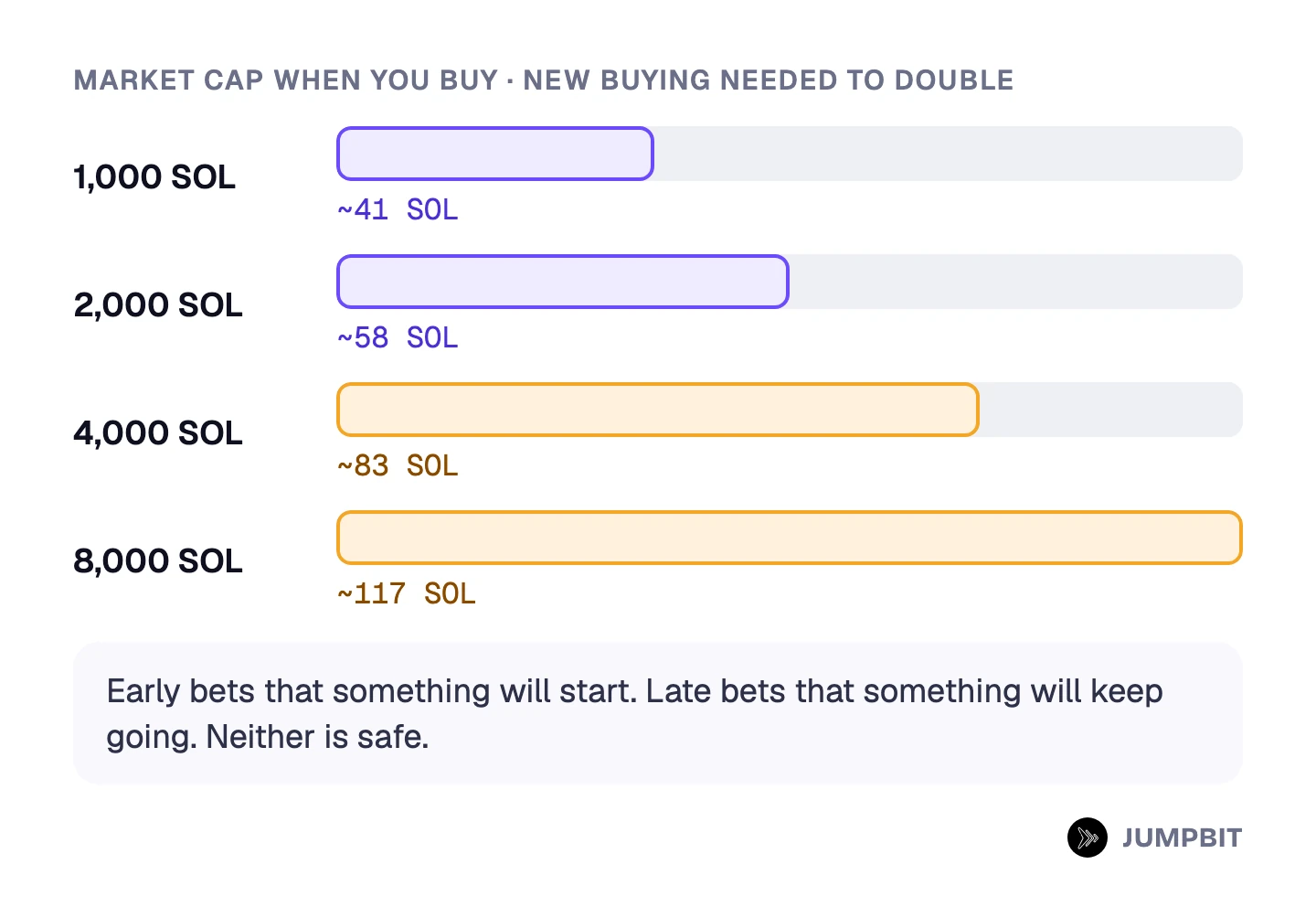
To double your money, the price has to double from where you bought. In a pool (chapter 1.5), doubling the price needs the SOL in the pool to grow by about 41%, after everyone's sells are counted. Bigger coins have bigger pools, so they need more new SOL to do it.
| $PEBBLE's market cap when you buy | SOL in its pool | Net new buying needed to double the price |
|---|---|---|
| 1,000 SOL | 100 | About 41 SOL |
| 8,000 SOL | About 283 | About 117 SOL |
That's net buying: every SOL that earlier holders take out by selling has to be bought back in first. The later you arrive, the more holders are sitting on a profit, and the more selling the new buyers have to soak up.
Early: cheap, and usually dead
Buying a new coin minutes after launch gets you close to the lowest price. It also puts you in the stage where most coins end. In our data on 2.9 million pump.fun launches in 2026, about seven in ten had their last trade within an hour of launch (chapter 1.9). Early is also when bundles, snipers and insiders are thickest (chapters 3.2–3.3), and when there's least information to check.
Late: proven, and you may be the exit
A coin that has run up has shown that attention exists. But:
- It needs more new SOL to keep going (the table above).
- Everyone before you is in profit. The creator, early buyers and everyone in the run can sell to you at a gain (chapter 5.2).
- The attention may already be peaking (chapter 5.1). By the time a coin reaches people who weren't looking for it, it often has.
Side by side
| Early | Late | |
|---|---|---|
| Price | Lowest | Much higher |
| Chance the coin dies soon | Highest | Lower, not zero |
| New SOL needed to double the price | Less | More |
| Who you buy from | Mostly the curve or the first wallets | Holders who are already in profit |
| Information to check | Very little | More |
Neither is safe. Early bets that something will start; late bets that something will keep going.
What it looks like for $PEBBLE
You hear about $PEBBLE when its market cap is 8,000 SOL, after it was 1,000 SOL yesterday. For your money to double, it must reach 16,000 SOL: which takes about 117 SOL of net new buying into a pool holding about 283. Meanwhile everyone who bought yesterday is sitting on up to an 8x gain, and every SOL they sell has to be bought back first.
The rule
Before you buy, say which bet you're making, start or continue, and what it needs to happen for your money to double.
Check yourself
Say your answer out loud or in your head first. Then open it and be honest about whether you got it.
- 1You buy a coin at a market cap of 5,000 SOL. What market cap does it need for your money to double?
- 2Why isn't buying late automatically safer?
- 3To double a coin's price, roughly how much must the SOL in its pool grow, after sells?
- 4Why does a coin you buy late need more net new buying to double?
- 5When are bundles, snipers and insiders thickest?
- 6Early and late buys are each a bet on what?
- 7Recap · 1.7Why should you compare coins by market cap and not by price?
Go deeper
Education, not financial advice. Crypto can lose all its value.