
Create vs launch
Create vs Launch: Making a Solana Token Is Not the Same as Putting It on the Market
Tell creating a token from launching it, and list the steps between the two.
Thinking that creating a coin puts it on the market. A newly created token sits in your wallet with no price and no buyers until you give it somewhere to trade.
Key terms in this chapter
- Creating
- Creating a token makes its mint account (chapter 1.4) and puts the supply you chose into your wallet. At that moment you hold 100% of it, it has a name and a logo, and nobody else can buy any, because there's nowhere to trade it.
- Launching
- Launching makes it tradable. Usually that means opening a pool with SOL on one side and your coin on the other (chapter 1.5). The ratio you deposit sets the first price.
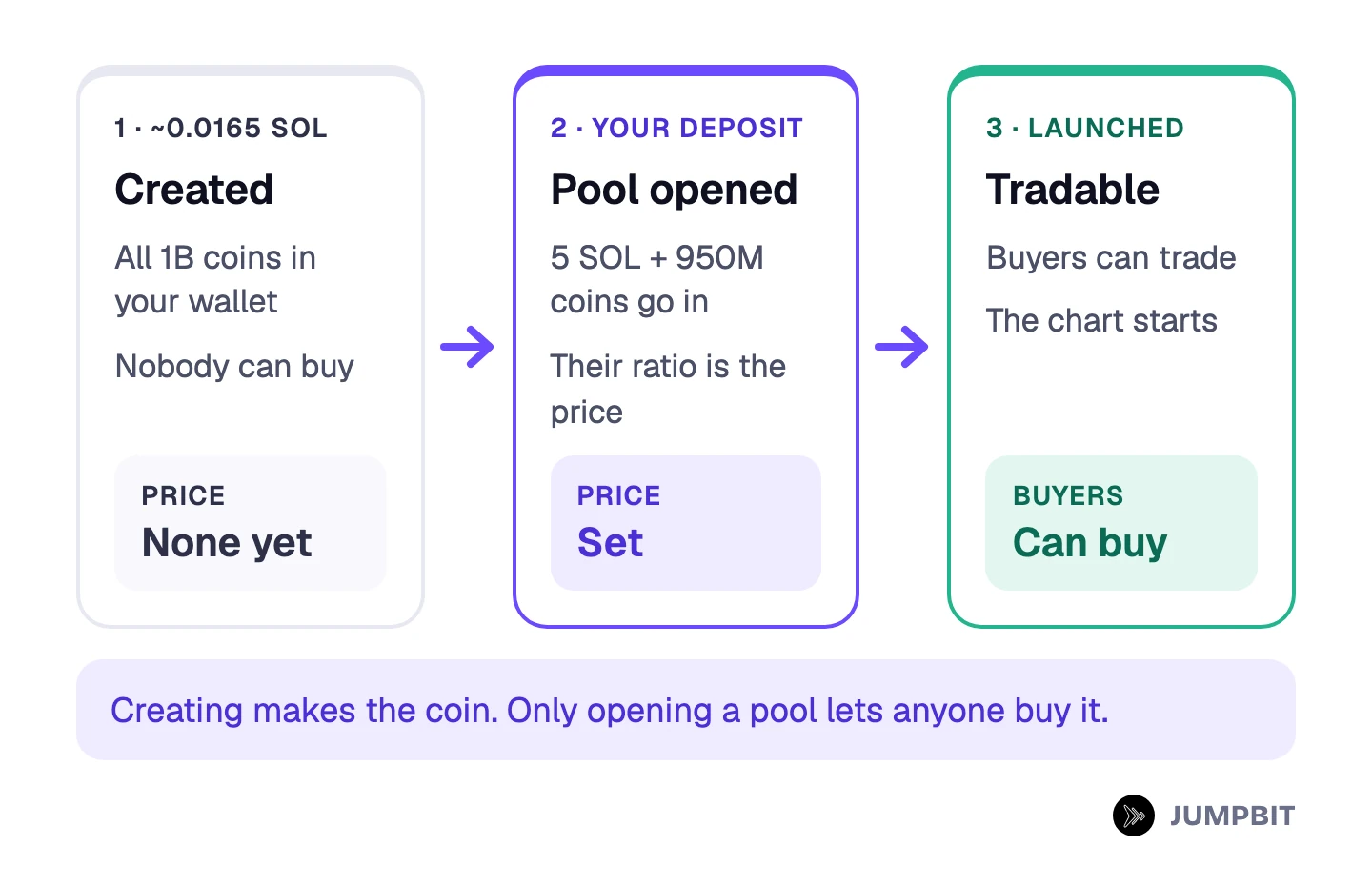
Two separate steps
Creating a token makes its mint account (chapter 1.4) and puts the supply you chose into your wallet. At that moment you hold 100% of it, it has a name and a logo, and nobody else can buy any, because there's nowhere to trade it.
Launching makes it tradable. Usually that means opening a pool with SOL on one side and your coin on the other (chapter 1.5). The ratio you deposit sets the first price.
Some launch sites combine both steps with a bonding curve (chapter 1.9). This module does them yourself, one at a time, so you choose and can show every setting buyers check.
The build, in order
| Chapter | Step | Which check it decides |
|---|---|---|
| 6.2 | Supply and decimals | How the price and market cap read |
| 6.3 | Token standard | Whether extra settings appear in the report |
| 6.4 | Name, logo and links | Whether buyers can match the coin to you |
| 6.5 | Revoke authorities | Mint and freeze, the two biggest flags |
| 6.6 | Address | Whether the address helps or misleads |
| 6.7 | Pool and LP | Liquidity, and whether it can be pulled |
| 6.8 | Airdrop | How the supply spreads to holders |
| 6.9 | Checklist | All of it, run in order |
What creating costs
Solana itself charges a few deposits to create the accounts a token needs: in our measurements on mainnet, about 0.0165 SOL for a standard token and 0.0045 SOL for a Token-2022 one. A creator tool adds its own fee on top. Jumpbit's Token Creator charges a flat 0.05 SOL.
Creating costs little. Launching is where the real money goes: the SOL you put in the pool.
The goal of this module
By chapter 6.9 you'll have a plan for a clean $PEBBLE: a coin that passes every step of the 60-second check (chapter 3.8). Clean doesn't mean it will rise. That depends on attention (chapter 5.1), which no setting can create. It means buyers who check will find no trap, and that's the part a creator controls.
The rule
Creating a coin is a minute's work. Launching it cleanly is a set of choices buyers will read, so make each one on purpose.
Check yourself
Say your answer out loud or in your head first. Then open it and be honest about whether you got it.
- 1You've just created a token. Can anyone buy it yet?
- 2What usually sets a newly launched coin's first price?
- 3Right after you create a token, how much of the supply do you hold?
- 4In our measurements, roughly what does Solana charge in deposits to create a standard token?
- 5Creating is cheap. Where does the real money go in a launch?
- 6Your coin passes every step of the 60-second check. Will its price rise?
- 7Recap · 3.8What are the six steps of the 60-second check?
Go deeper
Education, not financial advice. Crypto can lose all its value.