
Your coin’s pool and burning LP
Open Your Coin's Pool and Burn the LP: Proving Liquidity Can't Be Pulled
Open a pool for a coin, set its starting price, and burn the LP tokens so buyers can see the liquidity can't be pulled.
Thinking locked liquidity and burned liquidity are the same. A lock ends on a date and the liquidity can then be removed. Burning is permanent, and it's the one buyers trust most.
Choosing what goes in
The pool's two sides set the first price (chapter 1.5):
starting price = SOL you deposit ÷ coins you deposit
How much of your supply you put in matters too. Every coin you keep out of the pool shows up on the holder list as yours (chapter 3.5).
| Choice | What buyers see |
|---|---|
| Most of the supply in the pool | You hold little, so there's little you can sell into them |
| A small share in the pool, the rest in your wallet | "Dev still holds" a large share, a reason not to buy |
| A big SOL deposit | A deeper pool: less price impact for everyone (chapter 1.6) |
| A small SOL deposit | A thin pool. Rug Check warns about small pools, and honestly so |
Clean $PEBBLE's pool
| Clean $PEBBLE | |
|---|---|
| Supply | 1,000,000,000 |
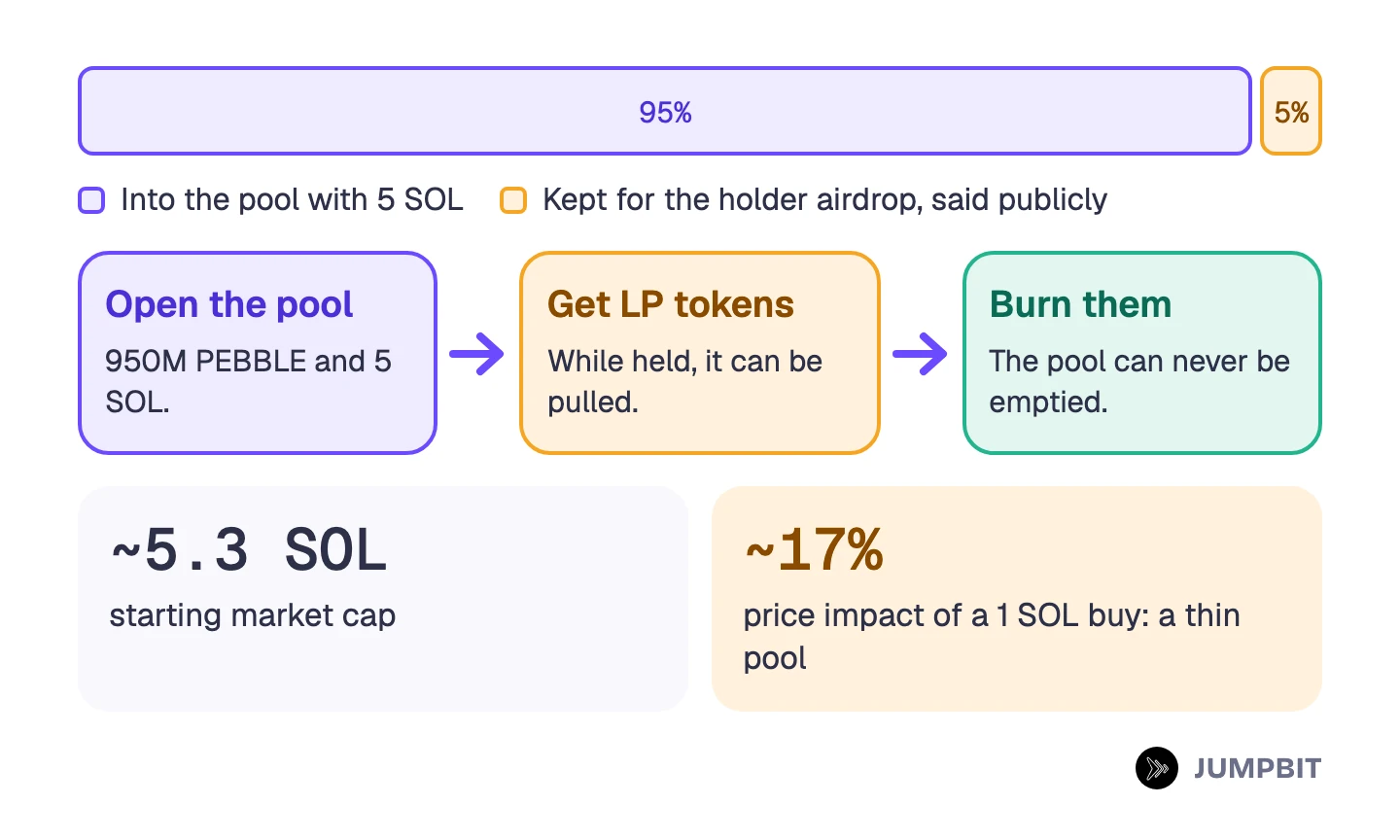
| Into the pool | 950,000,000 PEBBLE and 5 SOL |
| Kept back | 50,000,000 (5%), set aside for holder rewards (chapter 6.8) and said so publicly |
| Starting price | 5 ÷ 950,000,000 ≈ 0.0000000053 SOL |
| Starting market cap | About 5.3 SOL |
A 5 SOL pool is thin. A 1 SOL buy moves the price by about 17% (chapter 1.6). That isn't a trap, but buyers should know it, and so should you.
Opening it
Jumpbit's Liquidity tool creates a pool on PumpSwap's AMM or Raydium's CPMM. In our measurements, a PumpSwap pool costs about 0.0077 SOL in Solana deposits, and a Raydium CPMM pool about 0.18 SOL including Raydium's own 0.15 SOL fee. Jumpbit adds 0.05 SOL per pool. Your deposit of SOL and coins goes on top, and stays in the pool.
Burning the LP
When you open the pool, you receive its LP tokens (chapter 2.5). While you hold them, you can take the liquidity back out, and Rug Check will say so: "100% of liquidity can be pulled".
| What you do with the LP tokens | Can you remove the liquidity? |
|---|---|
| Burn them | Never |
| Lock them until a date | Not until the date |
| Keep them | Any time |
Jumpbit's burn tool burns LP tokens for PumpSwap AMM and Raydium CPMM pools, for 0.05 SOL plus network fees. A burn can't be undone, so check you've picked the right pool first. Then run your coin through Rug Check and confirm the liquidity line shows it locked.
Burning gives up your deposit for good: the 5 SOL and the coins stay in the pool forever. Only put in what you're willing to leave there.
The rule
Put most of the supply in the pool, burn the LP, and let Rug Check show buyers it can't be pulled.
Check yourself
Say your answer out loud or in your head first. Then open it and be honest about whether you got it.
- 1A pool holds 5 SOL and 950,000,000 coins, and the supply is 1 billion. What's the starting market cap?
- 2Your LP is locked for 30 days. What will buyers worry about?
- 3Why put most of the supply into the pool instead of keeping it?
- 4Clean $PEBBLE's pool holds 5 SOL. Roughly how much does a 1 SOL buy move the price?
- 5What do you give up for good when you burn the LP?
- 6After burning, how do you show buyers the pool can't be pulled?
- 7Recap · 2.5What can whoever holds a pool's LP tokens do?
Go deeper
Education, not financial advice. Crypto can lose all its value.