
Reading the holder list
How to Read a Token Holder List: Top Holders, the Pool and Concentration
Read a coin's holder list, leave out the pool, and say what share of supply the top 10 wallets hold.
Thinking the biggest holder on the list is a whale about to sell. Often it's the coin's own pool. The real question is how much the next ten wallets hold together.
Key terms in this chapter
- holder list
- The holder list ranks every wallet by how much of the supply it holds.
- concentration
- What matters is how much of the supply sits with a few wallets. This is called concentration.
Who holds the supply
Every coin's supply sits somewhere: in wallets, in its pool and sometimes in a locker or a burn address. The holder list ranks every wallet by how much of the supply it holds. Coin pages and explorers show it, usually as a percentage of supply.
The top holder is often the pool
Chapter 1.5 said a pool holds coins on one side of the box. Those coins count as "held" by the pool's address, so the pool often sits at the top of the list. It isn't a person, and it can't decide to sell.
Look for a label such as "pool", "liquidity" or the name of an exchange, and skip it. Do the same for a bonding curve on a coin that hasn't graduated (chapter 1.9), and for any burn or locker address.
Adding up the top 10
What matters is how much of the supply sits with a few wallets. This is called concentration.
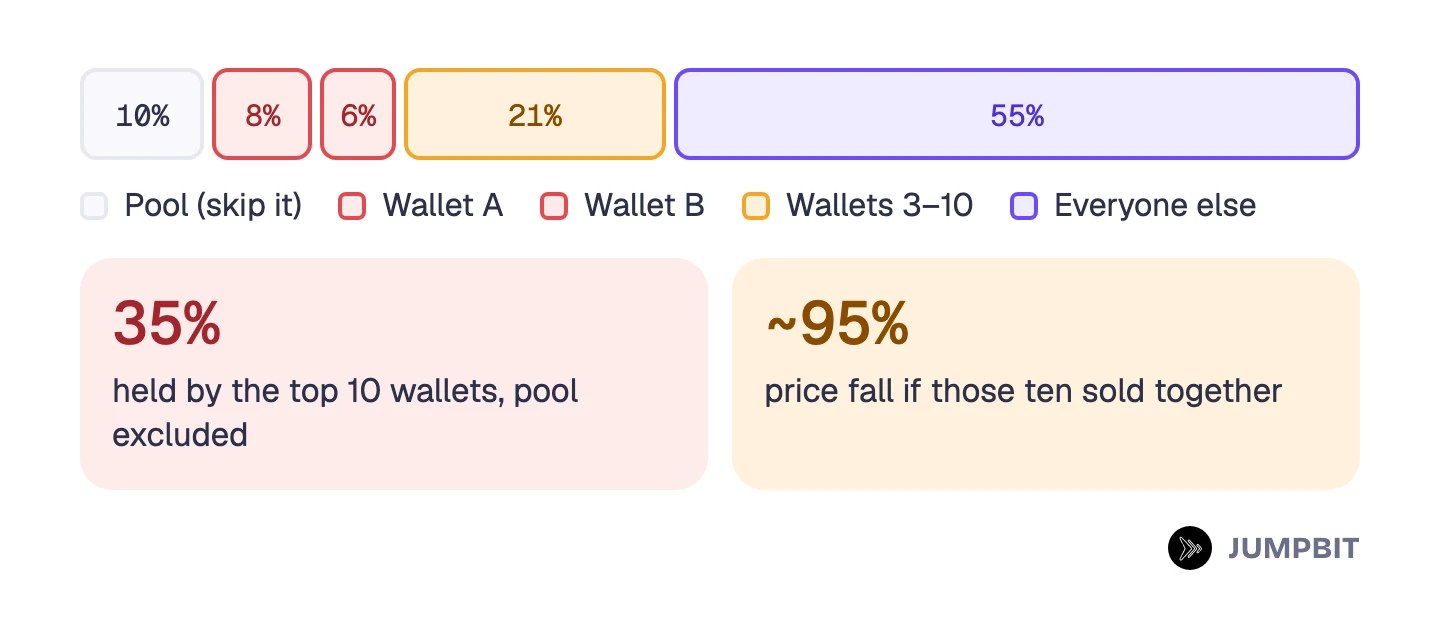
$PEBBLE's list, with the pool skipped:
| Rank | Holder | Share of supply |
|---|---|---|
| — | Pool (skipped) | 10% |
| 1 | Wallet A | 8% |
| 2 | Wallet B | 6% |
| 3–10 | Eight more wallets | 21% together |
| Top 10 wallets | 35% |
Ten wallets hold 350 million of $PEBBLE's 1 billion coins.
What if they sold?
Use the pool from chapter 1.5: 100 SOL and 100 million PEBBLE. If those ten wallets sold all 350 million together, the pool would end up with 450 million PEBBLE and about 22 SOL. The price would fall by about 95%, and those ten would leave with about 78 of the pool's 100 SOL.
They may never sell. But you're relying on ten wallets not to, and you can't see who controls them.
How much is too much?
There's no single right number. Jumpbit's Rug Check starts taking points off when the top 10 wallets, pools excluded, hold more than 20% of supply, and the penalty grows until 60%. It shows the flag as "Top 10 wallets hold" followed by the share.
The rule
Skip the pool, then add up the top 10. The bigger their share, the more a few sellers can do to the price.
Check yourself
Say your answer out loud or in your head first. Then open it and be honest about whether you got it.
- 1The top address on a coin's holder list holds 12%. Who is it likely to be, and what should you do with it?
- 2The top 10 wallets, without the pool, hold 60% of a coin. What does that mean for you?
- 3What does "concentration" mean on a holder list?
- 4Above what top-10 share, pools excluded, does Rug Check start taking points off?
- 5$PEBBLE's top 10 hold 350 million coins. If they all sold together into its 100 SOL pool, roughly what would happen?
- 6Ten wallets hold a third of a coin, but none has sold yet. Is that safe?
- 7Recap · 1.8Why can't all holders together sell a coin for its market cap?
Go deeper
Education, not financial advice. Crypto can lose all its value.