
Fake volume and fake holders
Fake Volume and Fake Holders: When a Memecoin's Activity Doesn't Add Up
Spot volume and holder numbers that don't add up, and say why neither proves real demand on its own.
Thinking high volume or a big holder count means lots of people want the coin. Both can be manufactured cheaply, and both are often used to pull in buyers.
Key terms in this chapter
- volume
- A coin's volume is the total value of its trades over a time, often 24 hours.
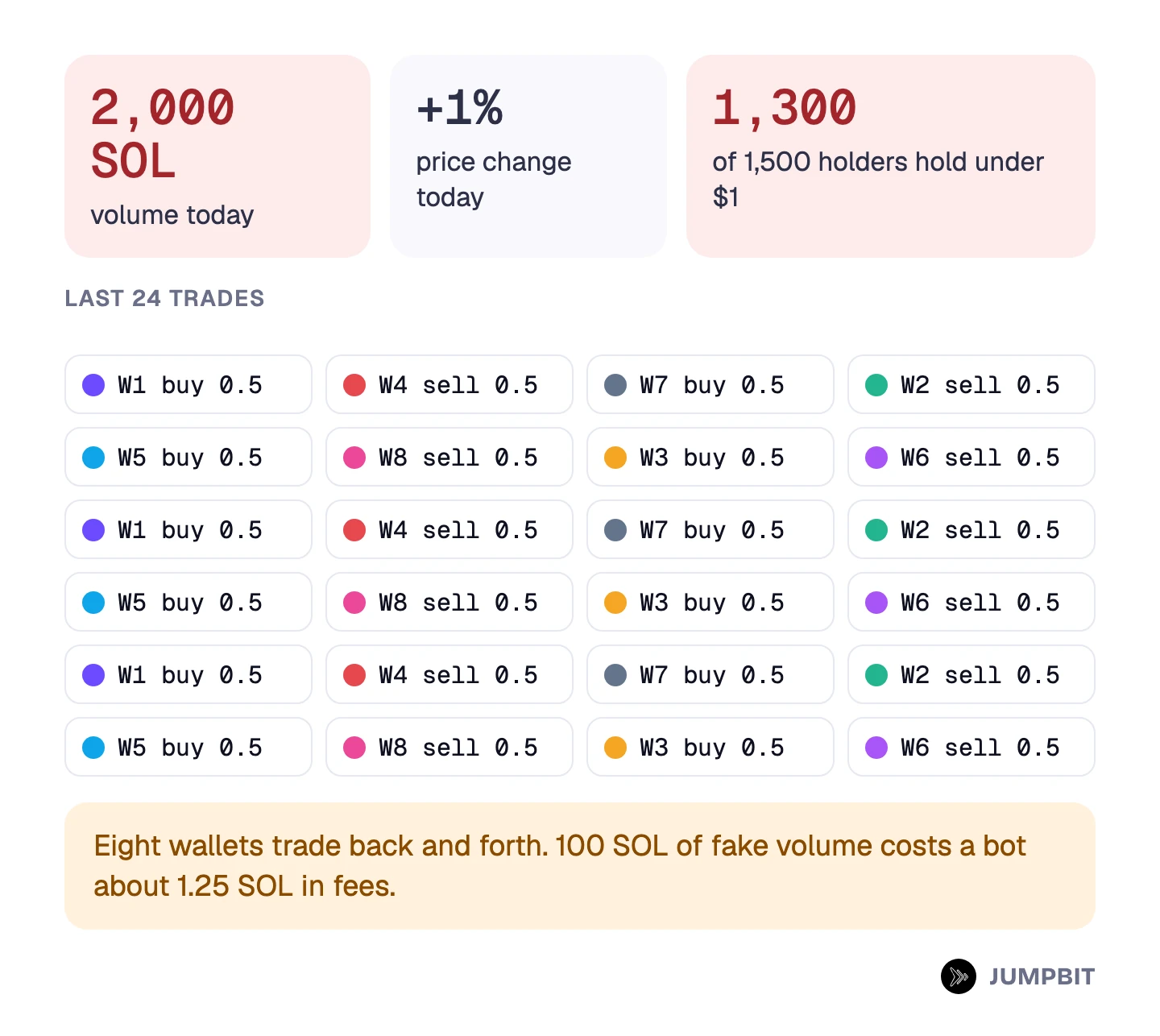
Volume can be bought
A coin's volume is the total value of its trades over a time, often 24 hours. Coin pages and lists rank coins by it, so higher volume means more people see the coin.
That's why some creators fake it. A volume bot buys and sells the same coin over and over from a few wallets. Every trade counts as volume, but no one new is buying. Each cycle only costs the fees: at a 1.25% pool fee, 100 SOL of fake volume costs about 1.25 SOL.
Signs the volume is fake
| What you see | Why it points to a bot |
|---|---|
| Trades of near-identical size, at regular times | People don't trade on a clock |
| High volume, but the price barely moves | Buys and sells cancel out |
| A few wallets make most of the trades | Real demand comes from many wallets |
Holders can be bought too
A big holder count looks like a crowd. But a creator can send a tiny amount of the coin to hundreds of new wallets, or buy a little from each. The count goes up; nothing else changes.
Signs the holders are fake:
- Hundreds of tiny, identical balances. Made in one batch.
- Wallets funded from one source within minutes. One owner (chapter 3.4).
- A big count, but a few wallets hold most of the supply. The count hides concentration (chapter 3.1).
What regulators say
The US Commodity Futures Trading Commission has warned about pump-and-dump schemes in thinly traded new coins, where organisers hype a coin in group chats and on social media, then sell into the buyers they attract. Its advisory tells people not to buy based on "social media tips or sudden price spikes."
Fake volume and fake holders are tools for that kind of hype: they make a coin look busy so that real buyers arrive.
What a $PEBBLE buyer sees
$PEBBLE shows 2,000 SOL of volume today and 1,500 holders. But its pool holds 100 SOL, the price has barely moved, and most trades are 0.5 SOL from the same eight wallets. 1,300 of the holders hold under a dollar each.
The real picture is a quiet coin with a few busy bots.
The rule
Treat volume and holder counts as claims, not proof. Check who's trading and who's holding.
Check yourself
Say your answer out loud or in your head first. Then open it and be honest about whether you got it.
- 1A coin has huge volume, but its price has barely moved and most trades come from a few wallets. What's likely going on?
- 2What did the US CFTC advise people not to base a coin purchase on?
- 3At a 1.25% pool fee, roughly what does 100 SOL of fake volume cost?
- 4Why would a creator fake volume at all?
- 5A coin has 1,500 holders, but 1,300 of them hold under a dollar each. What does that suggest?
- 6Trades of almost identical size keep landing at regular times. Why does that point to a bot?
- 7Recap · 3.5A creator's wallet has no earlier launches. Does that prove the creator is trustworthy?
Go deeper
Education, not financial advice. Crypto can lose all its value.