
Liquidity: locked, burned or pulled
Liquidity Locked, Burned or Pulled: How to Tell If a Pool Can Be Emptied
Tell burned, locked and pullable liquidity apart, and say what each means for someone holding the coin.
Thinking a coin's pool will always be there. On many coins, whoever added the liquidity can take it back out in one transaction, and the SOL buyers paid in leaves with it.
Key terms in this chapter
- LP tokens
- When they do, the pool hands them a receipt that proves their share, called LP tokens (LP stands for liquidity provider).
The receipt for the box
Chapter 1.5 described a pool as a box holding SOL and a coin. Somebody has to fill that box first. When they do, the pool hands them a receipt that proves their share, called LP tokens (LP stands for liquidity provider).
Whoever holds the LP tokens can hand them back to the pool and take out their share of what's inside: SOL and coins. Removing it all at once is how a liquidity rug pull works.
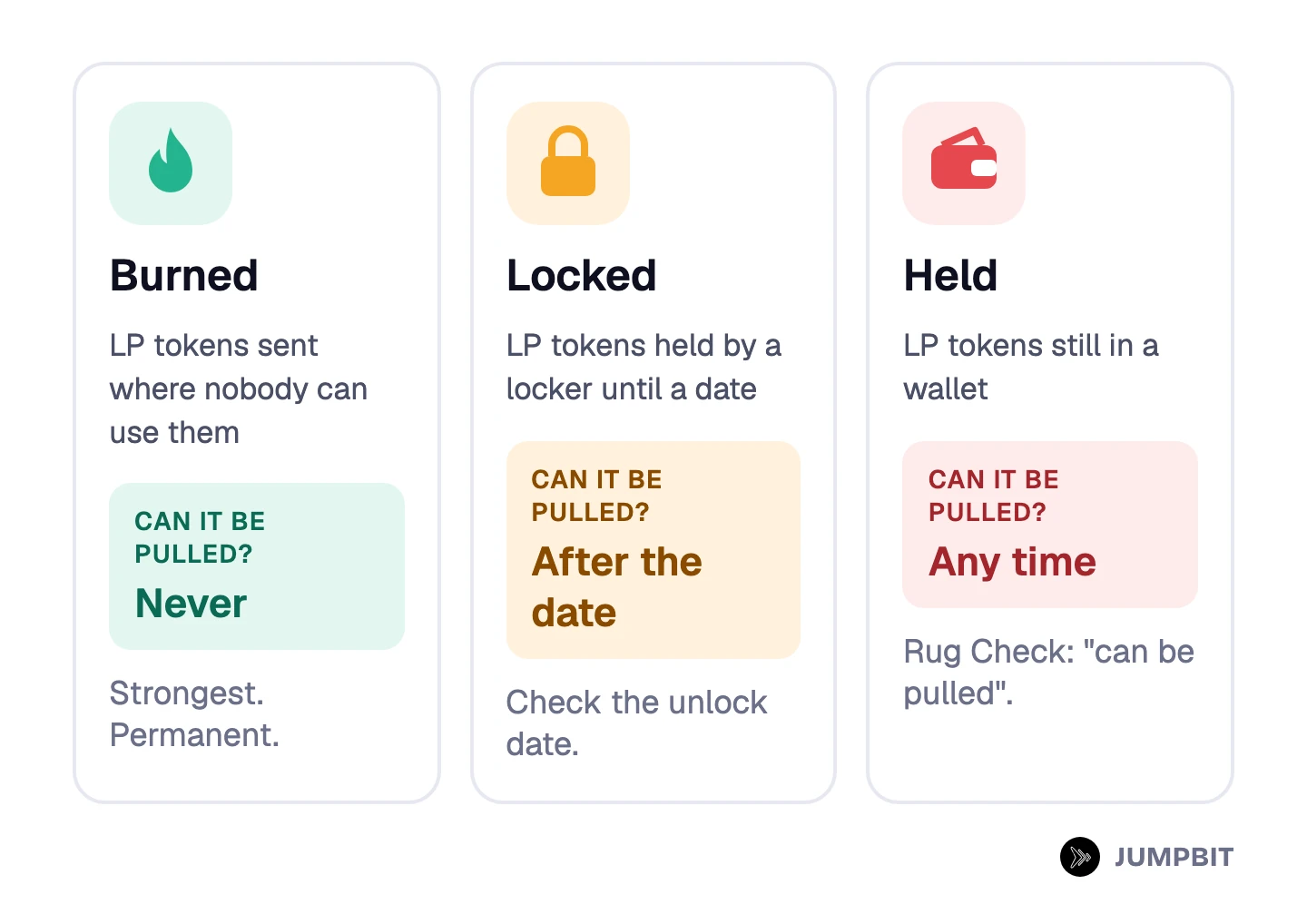
Three things that can happen to the receipt
| What happened to the LP tokens | Can the liquidity be pulled? |
|---|---|
| Burned (destroyed) | Never |
| Locked in a contract until a set date | Not until that date, then yes |
| Held in someone's wallet | Yes, at any time |
What a pull does to $PEBBLE
Suppose $PEBBLE's creator filled its pool with 100 SOL and 100 million PEBBLE, and kept the LP tokens. Buyers pile in and pay 50 SOL, so the pool now holds 150 SOL.
The creator hands back the LP tokens and takes out everything: all 150 SOL and the remaining coins. That's their own 100 SOL back, plus the 50 SOL buyers paid. The pool is empty. Buyers still hold their PEBBLE, but there's no SOL left to sell into, so the coins can't be sold for anything.
How often it happens
In our data, over the 30 days to 23 October 2026, we counted 1,572 PumpSwap pools where the first liquidity provider removed most of the pool's SOL after the price at least doubled, and the price then fell by 70% or more within an hour. The median pull came 19 minutes after the pool was created.
Graduation (chapter 1.9) protects against this on pump.fun: a graduated coin's LP tokens are burned, so its pool can't be pulled. Pools that people create themselves don't get that protection. In the 7 days to 23 October 2026, 88% of PumpSwap pools created for coins that didn't come from pump.fun had none of their LP burned.
What burned liquidity doesn't fix
Burning stops the pool being emptied by its creator. It doesn't stop a wallet holding lots of coins from selling them into the pool, which drains SOL the normal way (chapter 1.8). Module 3 shows how to check who's holding.
Jumpbit's Rug Check shows how much of a pool's LP is burned or locked, and flags the rest as "can be pulled".
The rule
Before you buy, check what happened to the LP tokens. Burned is the strongest. Locked lasts only until the date. Held means it can be pulled at any time.
Check yourself
Say your answer out loud or in your head first. Then open it and be honest about whether you got it.
- 1A coin's LP tokens are locked until next month. Can the liquidity be pulled today? Next month?
- 2A coin's LP tokens are burned. Does that mean nobody can drain SOL out of the pool?
- 3What are LP tokens?
- 4A creator puts 100 SOL into a pool, buyers add 50 SOL, and the creator pulls the liquidity. How much SOL leaves?
- 5Put burned, locked and held LP in order from safest to riskiest.
- 6In our data, how soon after a pool was created did the median liquidity pull happen?
- 7Recap · 1.9What happens to a pump.fun coin's liquidity when it graduates?
Go deeper
Education, not financial advice. Crypto can lose all its value.